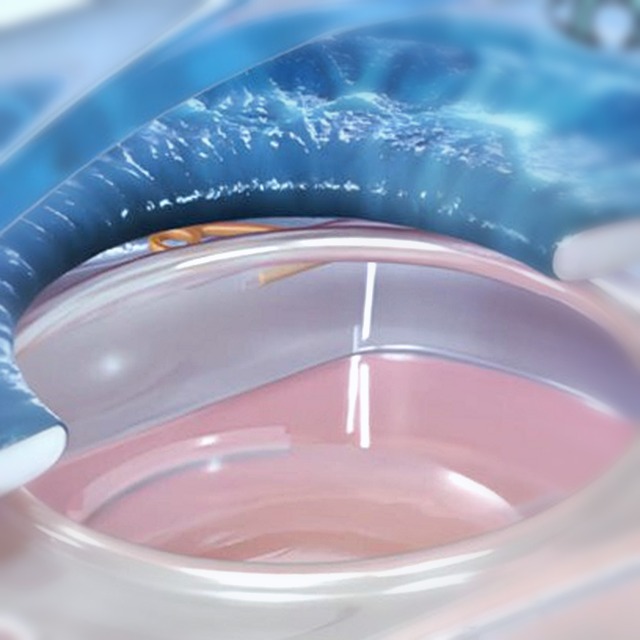
Despite remarkable advances in femtosecond laser fragmentation, swept-source optical coherence biometry, and multifocal optic profiles, cataract surgery still contends with a fundamental biological variable: the healing response of the human capsular bag. As the native capsule shrinks and fibroses around a conventional intraocular lens (IOL), even subtle shifts in effective lens position (ELP) or rotational alignment can degrade postoperative visual quality. Omega Ophthalmics is tackling this frontier head-on, securing $7 million in Series A funding to propel its Gemini Refractive Capsule toward regulatory submission and clinical trials.
Solving the Effective Lens Position Paradox in Premium IOL Implantation
Led by a syndicate of strategically aligned investors, Omega Ophthalmics’ $7 million Series A round—paired with a scheduled U.S. Food and Drug Administration (FDA) pre-submission meeting—funds manufacturing scale-up, intellectual property expansion, and pivotal clinical trial protocols. At the core of the platform is the Gemini Refractive Capsule, a prosthetic implantable device engineered to maintain an open, dimensionally stable three-dimensional space inside the native capsular bag.
In traditional phacoemulsification, once the crystalline lens is aspirated, the Anterior and Posterior capsules collapse around the haptics of the implanted IOL. Variations in capsular contraction can induce tilt, decentration, or myopic/hyperopic surprises—particularly problematic for toric, extended-depth-of-focus (EDOF), and trifocal optics that demand micron-level centration along the visual axis.
- 3D Capsular Preservation: Maintains an open, predictable anatomical volume within the native capsular bag rather than allowing asymmetric fibrotic collapse.
- Refractive Predictability: Stabilizes effective lens position (ELP) along the anteroposterior axis to sharpen refractive targets for premium toric and presbyopia-correcting IOLs.
- Atraumatic Lens Exchangeability: Creates a modular docking environment that allows surgeons to exchange or upgrade an IOL years after primary surgery without tearing fibrosed tissue.
- Future Tech Readiness: Provides standardized mechanical clearance for emerging biometric sensors, sustained-release drug reservoirs, and electro-active accommodating optics.
“By decoupling intraocular lens centration from the unpredictable wound-healing mechanics of the native capsular bag, modular prosthetic capsules transform cataract surgery from a static one-time event into an upgradable lifelong platform.”

Open-bag capsular prosthetic engineering aims to eliminate unpredictable fibrotic contraction and stabilize effective lens position over decades.
A Paradigm Shift for Co-Managing Optometrists and Anterior Segment Surgeons
For Canadian optometrists who co-manage pre- and post-operative cataract patients, counseling candidates on premium IOLs often involves navigating patient anxiety over permanent dysphotopsias, evolving macular pathology, or changing visual demands over a twenty-to-thirty-year lifespan. Today, explanting a fibrosed IOL months or years after surgery carries elevated risks of zonular dehiscence and vitreous prolapse.
As Omega Ophthalmics Chief Executive Officer Rick Ifland noted in announcing the Series A milestone, the Gemini platform is designed to deliver surgeons and patients unprecedented long-term flexibility. If a patient implanted with a diffractive trifocal lens develops age-related macular degeneration or glaucoma fifteen years later, a modular capsule could allow a straightforward, low-trauma swap to an aspheric monofocal optic.
Regulatory Trajectory and Manufacturing Scale-Up for Clinical Trials
With its FDA pre-submission meeting scheduled, Omega Ophthalmics is transitioning from preclinical validation to standardized cleanroom production and multicenter clinical study design. Regulatory scrutiny for permanent intraocular prosthetic scaffolds centers on long-term endothelial cell safety, aqueous humor dynamics, and prevention of posterior capsular opacification (PCO).
As refractive lens exchange and earlier-intervention cataract procedures grow across North American surgical centres, open-bag modular capsules represent one of the most closely watched structural innovations in anterior segment ophthalmology.
Key Takeaways
- $7M Series A Closed: Omega Ophthalmics secured $7 million in Series A capital to fund manufacturing scale-up, IP protection, and FDA clinical trial preparation.
- Open-Bag Stability: The Gemini Refractive Capsule preserves capsular bag geometry to lock in effective lens position and minimize rotational drift.
- Lifelong Upgradability: Modular docking architecture simplifies future IOL exchange and accommodates next-generation diagnostic or therapeutic ocular implants.