The global surge in childhood myopia—projected by epidemiological models to affect nearly five billion people by 2050—has transformed pediatric optometry from passive refractive correction into active axial-length management. Recognizing the profound public health impact of optical myopia control, TIME has named Essilor Stellest spectacle lenses to its prestigious list of the Best Inventions of 2026 in the Health & Wellness category.
Building on Historic Regulatory and Clinical Validation
While Canadian optometrists were among the earliest adopters in North America to integrate Highly Aspherical Lenslet Target (H.A.L.T.) spectacle technology into pediatric myopia clinics, the past year has cemented Stellest’s regulatory standing across the continent. Having first earned FDA Breakthrough Device designation in 2021, Essilor Stellest achieved U.S. Food and Drug Administration De Novo market authorization in September 2025—becoming the first and only FDA market-authorized spectacle lens proven to decelerate myopia progression in children.
TIME’s 2026 accolade highlights how optical physics can non-invasively alter the trajectory of pediatric eye growth. By pairing a sharp single-vision prescription zone with a constellation of 1,021 contiguous aspherical microlenslets spread across 11 concentric rings, the lens creates a three-dimensional volume of myopic defocus in front of the retina that signals the eye to slow axial elongation.
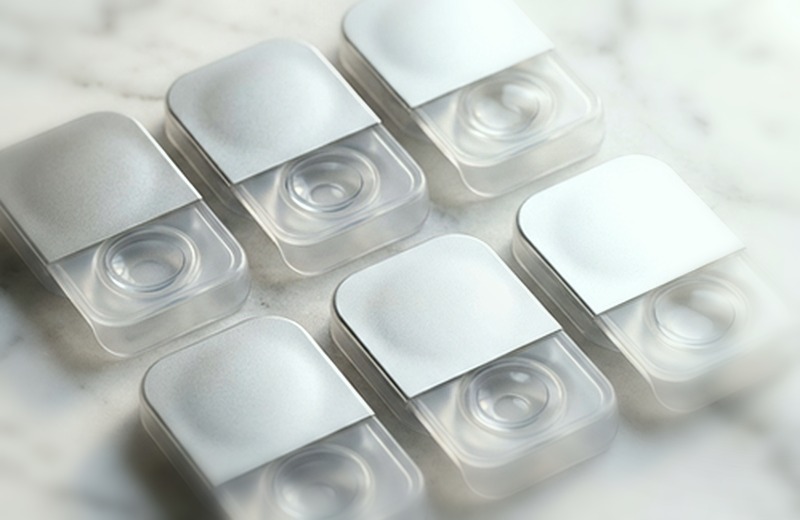
Evidence-based axial elongation control: Essilor Stellest’s H.A.L.T. lenslet architecture continues to earn global recognition following its landmark FDA De Novo market authorization.
Why Optical Myopia Control Resonates With Families
As Arnaud Ribadeau Dumas, Head of Product & Marketing Optical Categories at EssilorLuxottica, noted following the announcement, translating 175 years of optical research into an everyday pediatric intervention requires balancing clinical efficacy with real-world wearability:
- Non-Invasive First-Line Intervention: Spectacle-based myopia management allows clinicians to initiate treatment immediately in young children as soon as axial length or cycloplegic refraction crosses risk thresholds.
- High Visual Acuity & Adaptation: The H.A.L.T. optical geometry maintains clear central distance and near vision while delivering a continuous myopic defocus signal across peripheral gaze angles.
- Long-Term Ocular Health Protection: Slowing each diopter of pediatric progression significantly reduces lifetime risks of myopic maculopathy, retinal detachment, and open-angle glaucoma.
“Recognizing Essilor Stellest among TIME’s Best Inventions of 2026 affirms that early, evidence-based spectacle intervention can fundamentally safeguard the visual future of an entire generation.”
Mainstreaming Myopia Management in Canadian Dispensaries
High-profile mainstream recognition from publications like TIME carries an immediate clinical benefit for Canadian optometrists and opticians: it elevates parental awareness before the child even sits in the phoropter. Parents who previously viewed stronger yearly glasses as an unavoidable genetic rite of passage now enter the clinic asking specifically about myopia control technologies.
Armed with multi-year clinical trial data, FDA De Novo validation, and global innovation honors, Canadian practices are uniquely positioned to make axial length biometry and myopia-control spectacles the universal standard of pediatric care.
Key Takeaways
- Essilor Stellest lenses have been selected as one of TIME’s Best Inventions of 2026 in the Health & Wellness category.
- The honor follows Stellest’s September 2025 FDA De Novo authorization as the first U.S. market-authorized spectacle lens to slow childhood myopia.
- Mainstream visibility reinforces Canadian optometrists’ efforts to make early myopia intervention a routine standard of pediatric care.