In the fiercely competitive Canadian optical market of 2026, the independent practice cannot win on price. Aggressive online retailers and mass-market chains have monopolized the race to the bottom. To thrive, you must race to the top. The vehicle for that elite positioning? The science of storytelling.
Selling the Invisible
There is a fundamental psychological difference between a functional purchase and an emotional investment. When a patient walks into your dispensary, a pair of glasses is initially a grudge purchase—a medical necessity. The role of the master optician is to transform that necessity into an object of desire.
Consumers do not pay premium prices for acetate, titanium, and hinges. They pay for craftsmanship, heritage, and identity. When you merely list the features of a frame (“It’s lightweight and durable”), you invite price comparisons. When you tell its story (“This titanium was forged in Fukui, Japan, by a family that has been making frames for three generations”), you elevate the product beyond a price tag.
“You cannot combat an online discount by offering a smaller discount. You combat bad prices with great stories.”
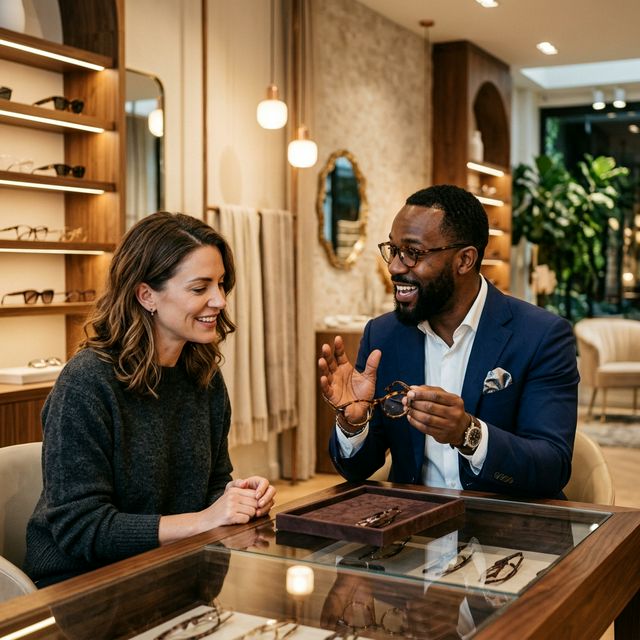
The way an optician physically handles a frame—holding it by the bridge with a pristine cloth—sets the stage for the story.
The Physiology of a Good Pitch
Modern neuroeconomics tells us that humans make purchasing decisions in the limbic system (the emotional center of the brain) and then justify those decisions in the neocortex (the logical center). If your dispensing pitch only addresses the neocortex (durability, warranty, price), you are fighting friction. By leading with a story, you bypass skepticism and engage the patient’s appreciation for luxury.
The 3-Part Frame Narrative
- The Origin: Where was the piece born? (e.g., “These frames are hand-carved in the Jura region of France.”)
- The Material: What makes the tactile experience unique? (e.g., “Notice the depth of color; this is cured Japanese Mazzucchelli acetate, aged for months so it won’t warp.”)
- The Identity: Who is this for? (e.g., “The designer specifically sculpted this bridge to sit perfectly on a narrower profile, which is why it looks like it was custom-made for you.”)
Choreography and “The White Glove” Experience
A story is ruined by poor delivery. Luxury storytelling requires physical choreography. When presenting an independent luxury frame, the optician should never hand it over with smudged fingers or slide it casually across a glass counter.
The frame must be presented on a soft leather tray or held carefully with a microfiber cloth. The physical reverence the optician shows the product subliminally communicates its high value before a single word is spoken. If you handle the frame like it is a precious artifact, the patient will treat it as one—and they will be prepared to pay accordingly.
Key Takeaways
- Features invite price matching; stories invite emotional investment.
- Structure your pitch around Origin, Material, and Identity.
- Treat the product with physical reverence to subconsciously elevate its perceived value.
- Train your staff on the specific heritage of your top three independent frame lines.
Frequently Asked Questions
Why is storytelling important in luxury retail?
Storytelling activates the emotional centers of the brain. In luxury markets, consumers are purchasing status, identity, and craftsmanship. A compelling narrative justifies the premium price point and creates a memorable experience that builds long-term loyalty.
How do you sell unknown independent eyewear brands?
You sell independent brands by leaning into their exclusivity. Educate the patient that mass-market logo brands are often produced in the same massive factories with low quality control. Position the independent brand as a hidden gem, focusing on its artisanal origins and superior materials.
How do you justify the cost of premium digital lenses?
Apply the same storytelling methodology to lenses. Do not talk about index numbers or anti-reflective coatings. Talk about visual comfort, minimizing digital eye strain, and the personalized, “tailored suit” nature of free-form digital surfacing.